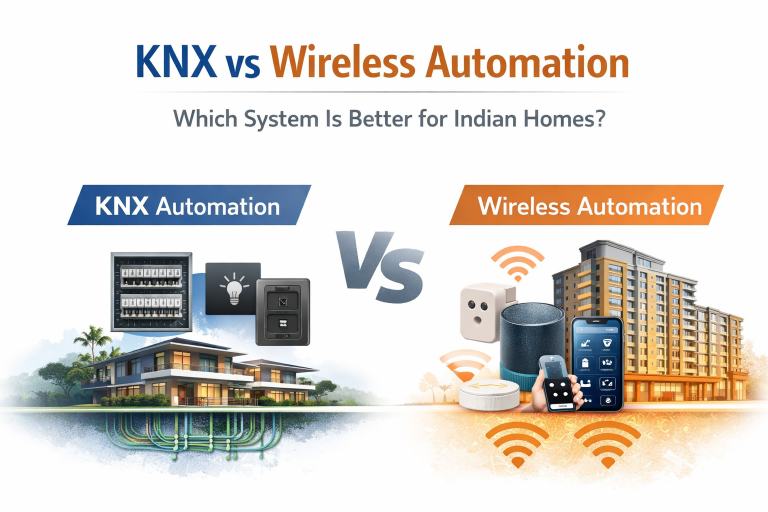
KNX vs Wireless Automation: Which System Is Better for Indian Homes?
If you’re planning a smart home today, one of the biggest decisions you’ll face is choosing between KNX and wireless automation systems. Most homeowners reach this stage after watching videos, visiting experience centres or speaking to multiple vendors. Suddenly, you are surrounded by unfamiliar terms. Wired. Wireless. KNX. Zigbee. Hybrid. It can feel overwhelming. This guide simplifies the comparison so you can make a confident decision that works for your home, your lifestyle and your long-term plans.
Why This Decision Matters More Than You Think
Automation is not like buying a TV or a speaker that you can easily replace after a few years. It becomes part of your home’s electrical and digital backbone. Choosing the right system affects reliability, future upgrades, resale value and daily comfort. Many Indian homeowners initially focus only on price or brand. Later they realise that system architecture matters even more.
Think of it like choosing between building a house with reinforced concrete or lightweight partitions. Both can work. But the right choice depends on your needs, stage of construction and long-term expectations.
What is KNX Automation?
KNX is a globally recognised wired home and building automation standard used in premium residential and commercial projects. Devices communicate through a dedicated bus cable that connects switches, sensors, actuators and controllers.
Because KNX is an open protocol supported by hundreds of manufacturers, homeowners are not locked into a single brand. This flexibility is one of the strongest reasons integrators recommend KNX for future-ready homes.
- Highly reliable communication independent of WiFi signal quality
- Scalable for villas, large apartments and commercial spaces
- Long lifecycle with support across multiple brands
- Ideal for structured lighting, climate and shading control
What is Wireless Automation?
Wireless automation systems use radio frequency based communication protocols such as Zigbee, Z-Wave, Bluetooth, WiFi or proprietary RF. Devices communicate without dedicated control wiring, which makes installation faster and less invasive.
Wireless systems have improved significantly over the last decade. Mesh networking allows devices to relay signals across rooms, improving coverage in Indian apartments with thick walls and multiple WiFi networks.
- Quick retrofit installation without civil work
- Lower initial cost compared to wired systems
- Ideal for rented homes or phased upgrades
- Works well for basic lighting and appliance automation
KNX vs Wireless Automation: Key Differences
| Factor | KNX Automation | Wireless Automation |
|---|---|---|
| Reliability | Very high due to wired communication | Depends on network design and interference |
| Installation Stage | Best during new construction or major renovation | Best for retrofit homes |
| Initial Cost | Higher upfront investment | More affordable starting point |
| Scalability | Excellent for large homes and future expansion | Limited by network strength and ecosystem compatibility |
| Maintenance | Stable long-term performance | May require network troubleshooting |
| Brand Flexibility | Multi-brand ecosystem | Often ecosystem dependent |
KNX India: Where It Makes the Most Sense
In India, KNX is commonly used in villas, luxury apartments and high-end renovation projects. Homeowners who value long-term reliability and integrated control across lighting, climate, security and AV systems often choose KNX.
Another advantage is resale perception. Premium automation infrastructure is increasingly viewed as a value addition in urban real estate markets.
For example, a 5000 sq ft villa with motorised blinds, centralised lighting scenes and multi-room audio will benefit significantly from KNX architecture. The system remains stable even when dozens of devices operate simultaneously.
Zigbee vs KNX: Practical Considerations
Zigbee is one of the most popular wireless protocols used in smart homes. It forms mesh networks where each powered device extends coverage. This makes Zigbee suitable for apartments where running new wires is difficult.
However, Zigbee performance depends on device density, signal interference and router placement. In dense Indian urban environments with multiple WiFi networks and concrete walls, careful planning becomes essential.
KNX, on the other hand, avoids these variables because communication happens through dedicated cables. This makes performance more predictable.
Wired vs Wireless Smart Home: Hybrid is Often the Answer
The truth is that many modern Indian homes use a hybrid approach. Critical loads such as main lighting circuits and climate control may be wired through KNX, while wireless devices handle secondary functions like table lamps or plug automation.
This balance reduces cost while preserving reliability. It also allows gradual expansion as budgets permit.
Budget Planning: What Should You Expect?
Automation budgets vary widely based on home size, brand selection and system complexity.
- Wireless starter automation for a 3BHK apartment can begin around ₹1.5 to ₹3 lakh.
- Hybrid automation with partial KNX integration may range between ₹4 to ₹8 lakh.
- Full KNX automation for large villas can exceed ₹10 lakh depending on features.
It is important to evaluate total lifecycle cost rather than only upfront pricing. Reliable systems often reduce maintenance expenses over time.
Common Mistakes Homeowners Make
- Choosing wireless systems for large homes without proper network design
- Installing KNX without future expansion planning
- Mixing too many incompatible ecosystems
- Ignoring user experience and focusing only on technology
- Underestimating importance of professional commissioning
Decision Guide: Which Automation System Should You Choose?
If you are still unsure whether KNX or wireless automation is right for your home, use this simple decision framework. Answering these practical questions can quickly clarify the best direction.
Are You Building a New Home or Doing a Major Renovation?
- Yes: This is the ideal stage to consider KNX automation. Structured wiring can be planned properly, ensuring long-term reliability, scalability and cleaner installations.
- No: If civil work is not possible or you live in a ready apartment, wireless automation systems offer a faster and less disruptive way to start.
How Large is Your Home?
- Large villas or apartments above 3000 sq ft: KNX is generally more stable and future-ready for handling multiple lighting circuits, climate zones, motorised curtains and AV integrations.
- Compact apartments or smaller homes: Wireless automation can deliver excellent functionality without heavy infrastructure investment.
How Important is Long-Term Reliability?
- Very important: Wired systems like KNX provide predictable performance because they do not depend on WiFi signal quality or RF interference.
- Moderately important: Well-designed wireless systems using mesh protocols like Zigbee can still perform reliably for many homes.
Do You Plan to Expand Automation in the Future?
- Yes, I want full-home automation eventually: KNX allows seamless scaling across lighting, climate, security and entertainment systems without replacing existing infrastructure.
- No, I only want basic control: Wireless systems can handle lighting scenes, plug automation and limited device integration efficiently.
What is Your Budget Strategy?
- I prefer investing upfront for long-term value: KNX automation typically requires higher initial investment but offers stability and lifecycle benefits.
- I prefer starting small and upgrading gradually: Wireless automation allows phased implementation and budget flexibility.
Are You Comfortable Managing Network Dependencies?
- Yes: Wireless systems rely on good router placement, signal planning and occasional troubleshooting.
- No: Wired automation reduces dependence on network performance for core functions.
Final Quick Recommendation
- If you are building or renovating and want premium long-term performance, KNX is usually the better choice.
- If you live in an existing apartment and want faster deployment with lower upfront cost, wireless automation is often more practical.
- If you want the best balance, a hybrid system combining KNX backbone with wireless flexibility can deliver excellent results.
Every home is different. A professional system design ensures you choose the right architecture rather than just the most popular one. ThingIQ specialises in designing premium wired, wireless and hybrid smart home solutions tailored to Indian homes. If you are planning automation for your home, you can connect with our team here for expert guidance.
FAQ
Is KNX worth the cost in India?
For large homes and long-term projects, KNX offers superior reliability and scalability.
Can wireless automation fail due to WiFi issues?
Yes. Poor network design or interference can impact performance.
Is Zigbee better than WiFi automation?
Zigbee mesh networks are generally more stable than standalone WiFi devices.
Can KNX be added later in an existing home?
It is possible but involves rewiring and higher installation effort.
Which system is better for resale value?
Structured wired automation like KNX is often perceived as premium infrastructure.
Do smart homes work without internet?
Professional systems like KNX continue operating locally even without internet.
Sources
- KNX Association Technical Overview View Source
- Connectivity Standards Alliance Zigbee Overview View Source
- Statista Smart Home Market India View Source
- Deloitte Smart Home Trends Report View Source
- Energy Efficiency and Automation Insights IEA View Source