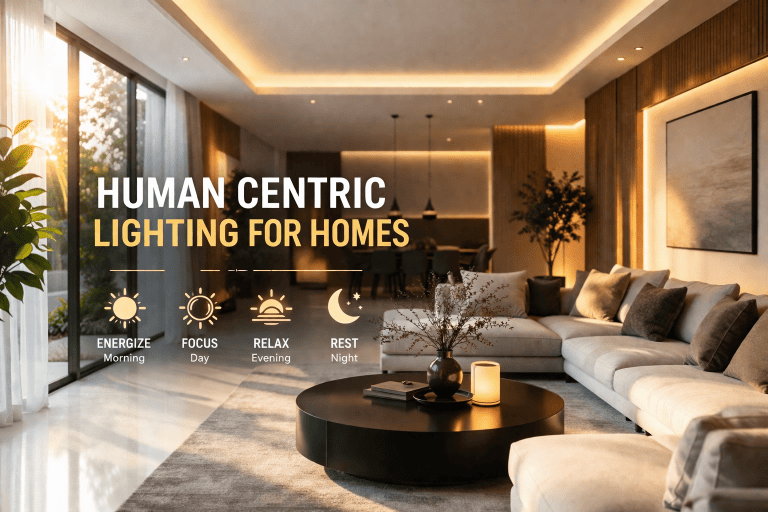
Human Centric Lighting for Homes: Benefits, Design Tips and System Choices
Have you ever noticed how some spaces just feel better? You walk in and instantly feel relaxed. Or more focused. Or simply comfortable without knowing why. Most people think it’s the interiors. The furniture. The colours. But a big part of that feeling comes from something we rarely think about properly. Lighting. Not just brightness. Not just fixtures. But how light changes throughout the day. This is where human centric lighting for homes comes in.
What is Human Centric Lighting?
Human centric lighting, often called HCL, is designed to match how natural daylight changes over the day.
Morning light is soft and energising. Afternoon light is bright and clear. Evening light is warm and calming.
Our bodies are naturally tuned to this rhythm. It’s called the circadian rhythm.
But modern homes don’t follow this.
- We use the same lighting all day. Same brightness. Same colour. Whether it’s morning or midnight.
- We focus only on fixtures, not the experience
- Ignoring colour temperature completely
- Not integrating lighting with automation
That disconnect is what HCL tries to fix. Lighting is not just about visibility. It’s about how your home feels.
Why This Matters More Than You Think
This is not just about aesthetics. It directly affects how you feel.
In many homes we work on, clients say things like:
- “Evenings feel too harsh”
- “Lighting feels tiring after a while”
- “Something feels off but I can’t explain it”
That “off” feeling is often lighting.
Once you shift to human centric lighting, the change is subtle but powerful.
Circadian Lighting Benefits in Daily Life
Let’s make this real. This is not about technology. It’s about how you feel in your home from morning to night.
Better Sleep Quality (This is the biggest one)
In most Indian homes, bright white lights are used even at 10 or 11 pm. That tells your brain it’s still daytime.
With human centric lighting, your home gradually shifts to warmer, dimmer light in the evening.
- Your body starts winding down naturally
- You feel sleepy at the right time
- Sleep quality improves over time
This is one of the most noticeable changes clients experience within a few weeks.
More Comfortable Evenings
Ever felt like your living room is too harsh at night, even though the design is perfect?
That’s usually because of cool white lighting.
Warm lighting in the evening:
- Feels softer on the eyes
- Makes the space more relaxing
- Improves how interiors actually look
This is why premium spaces like hotels and lounges always use warmer lighting at night.
Higher Energy and Focus During the Day
During the day, especially if you’re working from home, lighting plays a huge role.
Cooler and brighter light:
- Keeps you more alert
- Reduces that “afternoon dip” feeling
- Improves concentration without you realising it
This is especially relevant in Indian homes where natural daylight may not be consistent across all rooms.
Reduced Eye Strain and Fatigue
Static lighting creates contrast issues. Too bright in some areas, too dim in others.
With tunable lighting:
- Brightness adjusts gradually
- Glare is reduced
- Eyes feel less tired by the end of the day
This matters more than people realise, especially with long screen hours.
Subtle Emotional Impact
This is harder to measure but very easy to feel.
Your home feels calmer. More balanced. Less tiring.
It’s not a dramatic change. But once you experience it, going back to static lighting feels uncomfortable.
How Tunable Lighting Design Works
Tunable lighting means your lights can change colour temperature and brightness throughout the day.
| Time of Day | Lighting Type | Effect |
|---|---|---|
| Morning | Neutral to cool white | Wake up and energise |
| Afternoon | Bright cool white | Focus and clarity |
| Evening | Warm white | Relaxation |
| Night | Very dim warm light | Prepare for sleep |
This can be automated so you don’t have to think about it.
Design Tips for Human Centric Lighting at Home
Good HCL is not about adding more lights. It’s about designing light properly.
Layer Your Lighting (This is non-negotiable)
Relying on one central light is the biggest mistake.
You need layers:
- Ambient lighting: overall room illumination
- Task lighting: focused light for work or reading
- Accent lighting: coves, profiles, lamps
This allows your home to shift mood throughout the day.
Use Indirect Lighting as Your Base
Direct downlights alone create harsh shadows and glare.
Instead:
- Use cove lighting for soft ambient glow
- Add wall washers or profiles
- Keep downlights for functional zones only
This is what gives premium homes that calm, layered feel.
Get Colour Temperature Right (Very Important)
- Morning and work areas: 3500K to 5000K
- Evening and relaxation: 2200K to 3000K
Avoid using 4000K everywhere. That’s the most common mistake in Indian homes.
Focus on Key Spaces First
You don’t need to implement HCL everywhere immediately.
Start with:
- Living room
- Master bedroom
- Dining area
These spaces give you maximum impact.
Design for Transitions, Not Just Scenes
Lighting should not change abruptly.
Instead of switching from bright to dim instantly:
- Gradually reduce brightness
- Shift colour temperature slowly
This is what makes HCL feel natural.
Combine Lighting with Curtains
Natural light is part of the system.
Automated curtains can:
- Control daylight entry
- Reduce glare
- Work along with artificial lighting
This creates a complete lighting experience.
System Choices: How to Implement HCL in India
This is where most people get stuck. Let’s break it down in a practical way.
Option 1: Smart Bulbs (Entry Level)
This is the easiest way to get started.
What works:
- Use in bedrooms or small spaces
- Set basic schedules for warm evening lighting
Limitations:
- Not suitable for entire home
- Inconsistent experience across rooms
Think of this as testing HCL, not implementing it fully.
Option 2: Tunable LED Fixtures + Dimming Systems
This is where things get serious.
What to plan:
- Use tunable white LED strips or panels
- Ensure drivers support dimming and colour tuning
- Divide lighting into multiple controllable circuits
Practical tip:
Ask your lighting designer or integrator specifically for “tunable white lighting with dimming control”. Most standard setups won’t support this by default.
Option 3: Automation Systems (Recommended for Full Experience)
This is where HCL becomes seamless.
Systems like KNX or advanced automation platforms can:
- Automatically adjust lighting based on time of day
- Create smooth transitions instead of abrupt changes
- Integrate with curtains and occupancy sensors
What to plan early:
- Separate circuits for different lighting layers
- Dimming support in drivers and actuators
- Control interface (app, keypad, scenes)
This is best implemented during new construction or renovation.
Option 4: Hybrid Approach (Most Practical for India)
This is what works best in most real homes.
- Use automation for main lighting areas
- Use smart fixtures for secondary spaces
- Combine with manual override where needed
This balances cost, flexibility and performance.
One Important Reality
HCL is not a product you can buy. It’s a design approach.
The hardware enables it. But the real difference comes from how well the system is planned.
Is Human Centric Lighting Worth It?
If you’re already investing in a well-designed home, this is one of the upgrades that actually changes daily life.
It’s not dramatic. It’s not flashy.
But over time, you’ll notice:
- You feel more relaxed in the evenings
- Your home feels more balanced
- You don’t think about lighting anymore
That’s when you know it’s working.
Final Thoughts
Human centric lighting in India is still an emerging concept. But it’s quickly becoming a key part of premium home design.
The real value is not in technology. It’s in how your home supports your daily rhythm.
At ThingIQ, we design lighting and automation systems that go beyond switches and fixtures. If you’re exploring HCL for your home, you can connect with our team here to design a system that actually improves how you live.
FAQ
What is human centric lighting?
It is lighting designed to match natural daylight patterns and support human wellbeing.
Is HCL expensive?
It depends on system complexity, but scalable options are available.
Can I add HCL to an existing home?
Yes, using smart lighting systems and automation.
Does HCL improve sleep?
Yes, warm lighting in the evening supports better sleep cycles.
What is tunable lighting?
Lighting that can adjust colour temperature and brightness.
Is HCL useful in India?
Yes, especially in urban homes with limited natural light control.
Sources
- Harvard Health Light and Circadian Rhythm View Source
- Philips Human Centric Lighting Research View Source
- Lighting Research Center Studies View Source
- International WELL Building Institute View Source
- IES Lighting Standards View Source