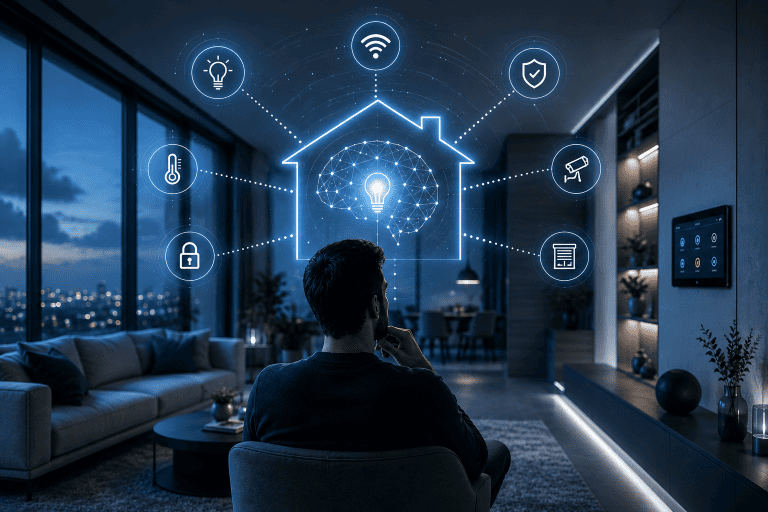
Future of Smart Homes: Matter, AI Automation and Predictive Living
A few years ago, most people thought smart homes were about controlling lights with a phone. Then came voice assistants. Then app-based automation. And honestly, for a while, the industry itself got distracted by gimmicks. Flashy demos, too many apps & too much complexity. But over the last couple of years, I’ve started noticing something different. The conversation is slowly shifting from “smart devices” to truly intelligent living. And I think the next phase of smart homes is going to feel very different from what we see today.
Not louder or futuristic looking, but more natural and intuitive.
The Smart Home Industry Is Finally Growing Up
For a long time, home automation felt fragmented.
One app for lights. Another for cameras. Another for speakers. Then something else for curtains.
Even technically good systems often felt disconnected from daily life.
I’ve seen this repeatedly in Indian homes.
People invest in expensive automation systems, but after a few months they stop using half the features because the experience feels complicated.
That’s the biggest lesson the industry is learning right now.
The future of smart homes is not about adding more control. It’s about removing friction.
Matter Might Quietly Change Everything
I genuinely think Matter is one of the most important developments in smart home technology in years.
Not because it’s flashy. But because it solves something painfully practical.
Compatibility.
Right now, homeowners constantly worry about:
- Will this device work with Apple?
- Will it integrate with Google or Alexa?
- Will I get locked into one ecosystem?
Matter changes that conversation.
At least in theory.
The idea that devices from different brands can communicate more seamlessly is a huge step forward for the industry.
Especially in India, where homeowners often mix products over time instead of buying everything together.
I don’t think Matter will magically solve every integration problem overnight. But I do think it reduces a major psychological barrier for homeowners.
People become more comfortable investing in smart homes when they feel future-ready.
The Most Interesting Shift Is Happening with AI Automation
This is where things get really interesting.
Most automation today still depends on manual triggers.
You press a button. You give a voice command. You activate a scene.
But AI automation changes the relationship completely.
The system starts learning patterns instead of waiting for instructions.
And honestly, I think this is where smart homes finally stop feeling “technical”.
What Predictive Living Actually Means
I don’t think predictive living means robots walking around your house. I think it means your home slowly understanding your habits.
Simple things.
- Lighting adjusting before sunset because it knows your evening routine
- Air conditioning preparing the bedroom before bedtime
- Music following your daily patterns
- Security systems understanding unusual behaviour
The system learns instead of you having to program every rule manually.
That’s a completely different kind of experience.
The Best Technology Will Become Invisible
This is something I strongly believe.
The future of smart homes is not more screens on walls.
It’s fewer moments where you even think about technology.
Right now, many smart homes still feel like operating systems.
In the future, good automation will feel more like good architecture.
You notice the comfort. Not the technology itself. That’s a subtle but very important shift.
Why India Is at an Interesting Turning Point
I think India is entering a very unique phase in the smart home market.
A few years ago, automation was mostly limited to luxury villas.
Now I’m seeing growing interest from:
- Young apartment buyers
- Professionals working from home
- People prioritising lifestyle and wellness
The mindset is changing.
People are no longer asking:
“Can automation switch lights?”
They’re asking:
“How does this improve daily living?”
That’s a much more mature conversation.
I Think Human-Centric Design Will Become Bigger Than Automation Itself
This is probably the most underrated trend.
The future is not automation for the sake of automation.
It’s homes designed around human comfort.
Lighting that supports sleep cycles. Audio that follows your mood. Climate control that adapts naturally. Spaces that feel calmer instead of more technical.
That’s why I think human centric lighting, wellness-focused environments and predictive automation will all merge together over the next decade.
The lines between interior design, wellness and technology are already starting to blur.
Will AI Replace Professional Integrators?
Honestly? I don’t think so.
If anything, I think the role becomes even more important.
Because smarter systems still need thoughtful design.
The challenge is no longer simply installing devices.
It’s understanding:
- How people live
- How spaces are used
- How technology should disappear into the experience
That requires design thinking, not just hardware knowledge.
The Real Risk Nobody Talks About
I also think the industry needs to be careful.
Not every smart feature improves life.
There’s a danger of creating homes that feel overly automated, intrusive or mentally exhausting.
Too many notifications. Too much dependency. Too many systems constantly asking for attention.
The future should not feel like living inside software.
The best smart homes will probably feel quieter, simpler and calmer.
So What Will Homes Feel Like in 10 Years?
I think the biggest change will be emotional, not technical.
Homes will become more adaptive.
More aware of routines. More energy efficient. More personalised.
And eventually, technology will fade into the background the same way good lighting or air conditioning does today.
You stop noticing the system itself.
You only notice how the home makes you feel.
Final Thoughts
I don’t think the future of smart homes is about chasing futuristic gadgets anymore.
I think it’s about creating homes that quietly support daily life without demanding constant interaction.
Matter, AI automation and predictive living are all steps in that direction.
And honestly, I think we’re still very early in this journey.
At ThingIQ, we spend a lot of time thinking about how technology should integrate naturally into modern homes instead of overwhelming them. If you’re exploring smart home automation for your home, you can connect with our team here to discuss future-ready solutions designed around real living.
FAQ
What is Matter in smart homes?
Matter is a smart home standard designed to improve compatibility between devices and ecosystems.
What is predictive living?
It refers to smart homes that learn user behaviour and automate experiences proactively.
Will AI become important in home automation?
Yes. AI is expected to make automation more adaptive and less manual.
Are smart homes becoming more common in India?
Yes, especially in urban apartments and premium homes.
Will future smart homes need apps?
Probably less than today. Future systems will rely more on automation and context awareness.
Is Matter replacing KNX or professional systems?
No. Matter improves consumer device interoperability, while KNX and professional systems still offer deeper integration and reliability.
Sources
- Connectivity Standards Alliance Matter Documentation View Source
- Google Home Matter Overview View Source
- Apple Home Matter Support View Source
- McKinsey Smart Home and AI Reports View Source
- Deloitte Future of Connected Living Research View Source
- KNX Association Smart Home Insights View Source