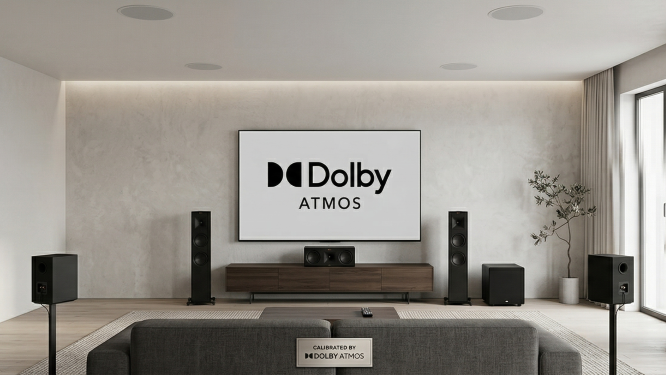
Dolby Atmos Explained for Home Theatres: What You Need to Know Before Buying
If you’ve ever walked into a cinema and felt sound moving around you, above you, and through you, that’s Dolby Atmos at work. And naturally, the next thought is this: can I get this experience at home? The answer is yes. But the journey from excitement to a proper Dolby Atmos home theatre is where most homeowners get confused. Speaker types, room size, ceiling speakers, soundbars, AV receivers. It quickly becomes overwhelming. This guide breaks it down in a simple, practical way so you can understand what really matters before you invest in an immersive audio home setup.
What is Dolby Atmos and Why Everyone Talks About It
Traditional surround sound systems like 5.1 or 7.1 work in channels. Sound is assigned to fixed speakers around you. Dolby Atmos takes this further. It treats sound as objects that can move freely in a three dimensional space.
That means instead of just hearing sound from the sides or behind, you also hear it from above. Rain feels like it’s falling from the ceiling. Helicopters sound like they are flying over your head. It creates a much more realistic and immersive experience.
This is why Dolby Atmos home theatre systems have become the standard for modern home cinema setups.
How Dolby Atmos Works in a Home Setup
At its core, an Atmos system adds height to your audio experience. This is achieved through either ceiling speakers or upward firing speakers.
- Ceiling speakers: Installed in the ceiling for the most accurate overhead sound.
- Up-firing speakers: Placed on top of regular speakers, reflecting sound off the ceiling.
A typical Atmos setup is written like this:
- 5.1.2 → 5 surround speakers + subwoofer + 2 height speakers
- 7.1.4 → 7 surround speakers + subwoofer + 4 height speakers
The last number always represents height channels, which is what makes Atmos different.
Dolby Atmos Home Theatre Configurations Explained
| Configuration | Best For | Experience Level |
|---|---|---|
| 5.1.2 | Small to medium rooms | Entry level Atmos |
| 5.1.4 | Medium rooms | Balanced immersive sound |
| 7.1.4 | Dedicated theatre rooms | High-end cinematic experience |
For most Indian homes, especially apartments, a 5.1.2 or 5.1.4 setup offers a great balance between performance and practicality.
Ceiling Speakers vs Up-Firing Speakers: What Should You Choose?
This is one of the most common decisions homeowners struggle with.
Ceiling Speakers (Best Performance)
- True overhead sound placement
- More accurate and immersive
- Requires wiring and installation planning
Up-Firing Speakers (Convenience Option)
- Easier installation
- No ceiling work required
- Performance depends on ceiling height and reflectivity
In India, where many apartments have false ceilings, ceiling speakers are usually the better long-term choice if planned early.
Room Size and Layout: The Most Ignored Factor
Many people focus only on speakers and brands. But room size and layout play a much bigger role than most realise.
- Small rooms: Avoid too many speakers. It can make sound cluttered.
- Medium rooms: Ideal for 5.1.4 setups.
- Large rooms: Can support 7.1.4 or higher configurations.
Ceiling height also matters. If the ceiling is too high, up-firing speakers lose effectiveness. If it’s too low, the sound can feel compressed.
This is why proper AV room planning is critical before buying equipment.
Speaker Placement Basics for Dolby Atmos
Speaker placement can make or break your system. Even expensive speakers won’t perform well if placed incorrectly.
- Front speakers should be at ear level and evenly spaced.
- Center speaker should align with the screen.
- Surround speakers should be slightly behind the seating position.
- Ceiling speakers should be placed above the listening area, not too far forward or backward.
Think of your seating position as the center of a sound bubble. All speakers should be arranged around that point.
AV Receiver: The Brain of Your System
An AV receiver is what powers and controls your entire Dolby Atmos system. It processes audio signals and distributes them to each speaker.
Key things to check:
- Number of channels supported
- Dolby Atmos compatibility
- Power output for your room size
Choosing the right receiver is as important as choosing speakers.
Dolby Atmos Soundbars vs Full Home Theatre Systems
Many homeowners consider soundbars as a simpler alternative.
Soundbars
- Compact and easy to install
- Good for small rooms
- Limited immersive effect
Full Home Theatre Systems
- True surround and height experience
- Better for larger rooms
- Requires planning and installation
If your goal is a true immersive audio home experience, a dedicated speaker system will always outperform a soundbar.
Home Theatre Budget India: What Should You Expect?
Costs vary depending on brands, room size and system complexity.
- Basic Atmos soundbar setup: ₹50,000 to ₹1.5 lakh
- Entry-level 5.1.2 system: ₹2 lakh to ₹4 lakh
- Premium 7.1.4 setup: ₹6 lakh and above
It’s better to invest in fewer high-quality components than to stretch your budget across too many speakers.
Common Mistakes to Avoid
- Ignoring room acoustics and treatment
- Choosing incorrect speaker placement
- Buying based only on brand names
- Underestimating wiring and installation requirements
- Expecting soundbars to match full systems
A well-designed system always outperforms a poorly planned expensive setup.
Final Thoughts
Dolby Atmos is one of the most impactful upgrades you can make to your home entertainment experience. But the real difference comes from how well the system is designed, not just the equipment you buy.
At ThingIQ, we specialise in designing and installing premium home theatre and immersive audio systems tailored to Indian homes. If you are planning your own Dolby Atmos home theatre, you can connect with our team here for expert guidance.
FAQ
Is Dolby Atmos worth it for home theatres?
Yes. It significantly improves immersion compared to traditional surround sound.
Do I need ceiling speakers for Atmos?
Ceiling speakers provide the best performance, but up-firing speakers can work in some setups.
What is the ideal Atmos setup for apartments?
A 5.1.2 or 5.1.4 configuration is ideal for most Indian apartments.
Can I upgrade my existing system to Atmos?
Yes, if your AV receiver supports Atmos and you can add height speakers.
Does room size affect Atmos performance?
Yes. Room size and layout play a major role in sound quality.
Are soundbars good for Atmos?
They offer a basic experience but cannot match full speaker systems.
Sources
- Dolby Atmos Official Guide View Source
- Crutchfield Speaker Placement Guide View Source
- AVS Forum Home Theatre Setup Discussions View Source
- RTINGS Soundbar and Audio Reviews View Source
- What Hi-Fi Dolby Atmos Reviews View Source